 English
News ·
News ·
News ·
News ·
News ·
News ·
News ·
News ·
News ·
News ·
News ·
News ·
News ·
News ·
News ·
News ·

About us
Our team is proud to offer on time guarantee and product guarantee to customer satisfaction.
Read Morecontact info
- No.186 Xianglong Road, Lishui City, 323000 Zhejiang, China
- +86-13666550158
- lydia@thebalde.com
Posted by Wangong
How to Select a Lead Screw Nut Housing for Your Assembly
A lead screw nut housing connects the nut to the moving assembly. Choosing one starts with the nut drawing and the machine layout: a similar-looking block may have a different bore, mounting pattern or center height. Check these interfaces before comparing housing materials or requesting a quotation.
This guide covers the information to collect when selecting a housing and the checks to discuss with your component supplier. Use the actual assembly drawings and manufacturer instructions for dimensions, tolerances and installation requirements.
1. Lead Screw Nut Housing Compatibility: Check the Nut Interface
Identify the exact nut model and the way it attaches to the housing. Record the nut body diameter, overall length, flange dimensions and fixing-hole pattern where applicable. Check how the nut is retained and whether its orientation affects access to lubrication points or other features.
Screw diameter and lead alone do not establish housing compatibility. Two assemblies using the same screw size can have different nut profiles and mounting arrangements. Send the nut drawing alongside the housing requirement so both interfaces can be reviewed together.
2. Lead Screw Nut Housing Mounting Dimensions
Review the available installation space, housing footprint, mounting-hole positions and screw-axis height relative to the carriage. Include the locating surfaces or features used by the machine design. Check clearance throughout the intended travel, including nearby guards, fixtures and fasteners.
For existing machines, record the installed arrangement before ordering a replacement. A block that fits the bolt pattern may still place the screw axis at a different height. Confirm the reference surfaces and dimensions used in the original assembly.
To compare available configurations, review Wangong's coupling and nut housing range, then confirm the selected model against your drawings.
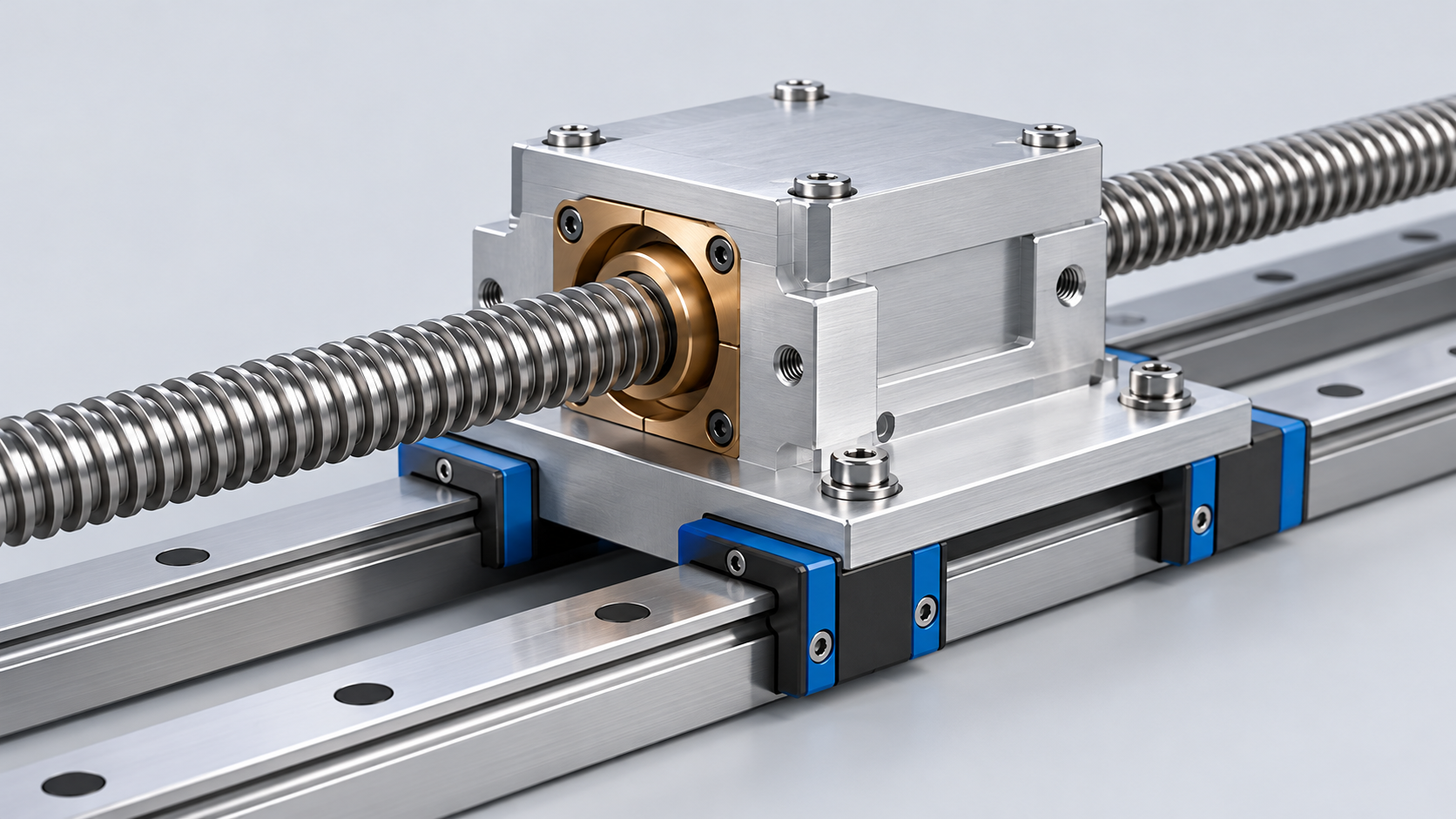
3. Lead Screw Nut Housing Alignment
The housing, screw supports and guide system need to work within the alignment requirements of the selected components. Do not use tightened mounting bolts to force an assembly into a position that conflicts with its locating surfaces or screw axis.
Follow the component manufacturer's installation procedure. If movement binds or resistance changes along the travel, investigate the assembly before operation. Possible checks include mounting surfaces, alignment, clearances and component condition; a housing change alone does not identify or resolve every cause.
4. Distinguish the housing from the nut mechanism
A lead screw nut and a ball screw nut use different motion interfaces. Their housings also depend on the specific nut geometry and assembly design. Do not assume that a lead screw housing and a ball nut housing are interchangeable because their outside shapes look alike.
If your application uses a ball screw, start with the selected nut's drawing. Wangong's ball screw range provides a starting point for comparing product families; the mating housing still needs its own fit check.
5. Include operating conditions and service access
Share the load direction, intended travel, operating speed, duty cycle and working environment. Ask the supplier to check the proposed housing and attachment arrangement against those requirements. Material choice should be reviewed together with the assembly design rather than treated as a universal ranking of aluminum and steel.
Leave access to the lubrication points, mounting fasteners and inspection areas required by the selected components. Consider dust protection, available maintenance space and how the nut or housing will be removed when servicing the machine. Do not add lubricant types, torque values or performance ratings without the applicable technical instructions.
6. Lead Screw Nut Housing Quotation: Prepare Your Purchasing Requirements
Before requesting a nut housing, collect:
- The screw and nut model, with their dimensional drawings.
- The housing or carriage drawing, including mounting holes and screw-axis height.
- The sample quantity, expected batch quantity and whether the request is for a new assembly or a replacement.
- The load direction, travel, speed, duty cycle and working environment.
- Any locating, lubrication-access or maintenance constraints.
For a bulk order, agree on the drawing revision, required inspection records, sample approval criteria, packaging requirements and delivery schedule with the supplier before placing the order. Confirm which requirements the supplier can meet; do not assume that a catalog listing establishes custom manufacturing capacity or a guaranteed lead time.
Mark dimensions that are fixed by the machine design and identify any dimensions still open for discussion. For a replacement, include photographs of the installed assembly as supporting information alongside measured dimensions and drawings.
Contact Wangong with your nut and mounting drawings to discuss the required configuration and the information needed for model selection.
keep
in touch.
in touch.
-

Address: No.186 Xianglong Road, Lishui City, 323000 Zhejiang, China
-

E-Mail: lydia@thebalde.com
-

Tel: +86-13666550158
Copyright © 2026 Lishui Wangong Precision Machinery Co., Ltd.
Ball Screw Manufacturer